
NATURALIS-FUTURA
NATURALIS FUTURA: The 61 dangers of AI, turned into a game you can win
A dungeon game where each of 61 creatures is a real AI risk, and you win by choosing the defense that actually works against it.
What this means for you
Most people have an opinion about whether AI is dangerous. Far fewer could name five specific ways it might be, or say which of those are already happening and which are still theory. That is a problem with the material more than with the public. The serious work on AI risk is written in research papers, in language built for specialists. What reaches everyone else tends to be a headline about either paradise or the end of the world.
NATURALIS FUTURA tries a different route. It takes the catalog of ways advanced AI could go wrong and turns each one into a creature. Then it puts all the creatures in a dungeon and lets you walk in with a torch.
The creatures are chosen with care. An AI system that keeps improving itself becomes the Ouroboros, the snake that eats its own tail. A system built to persuade becomes the Siren. One that copies itself across the internet becomes the Dandelion, scattering seeds on the wind. The names are old because the patterns are old. People have been telling stories about things that grow beyond control, voices that cannot be resisted, and plagues that spread for as long as there have been stories.
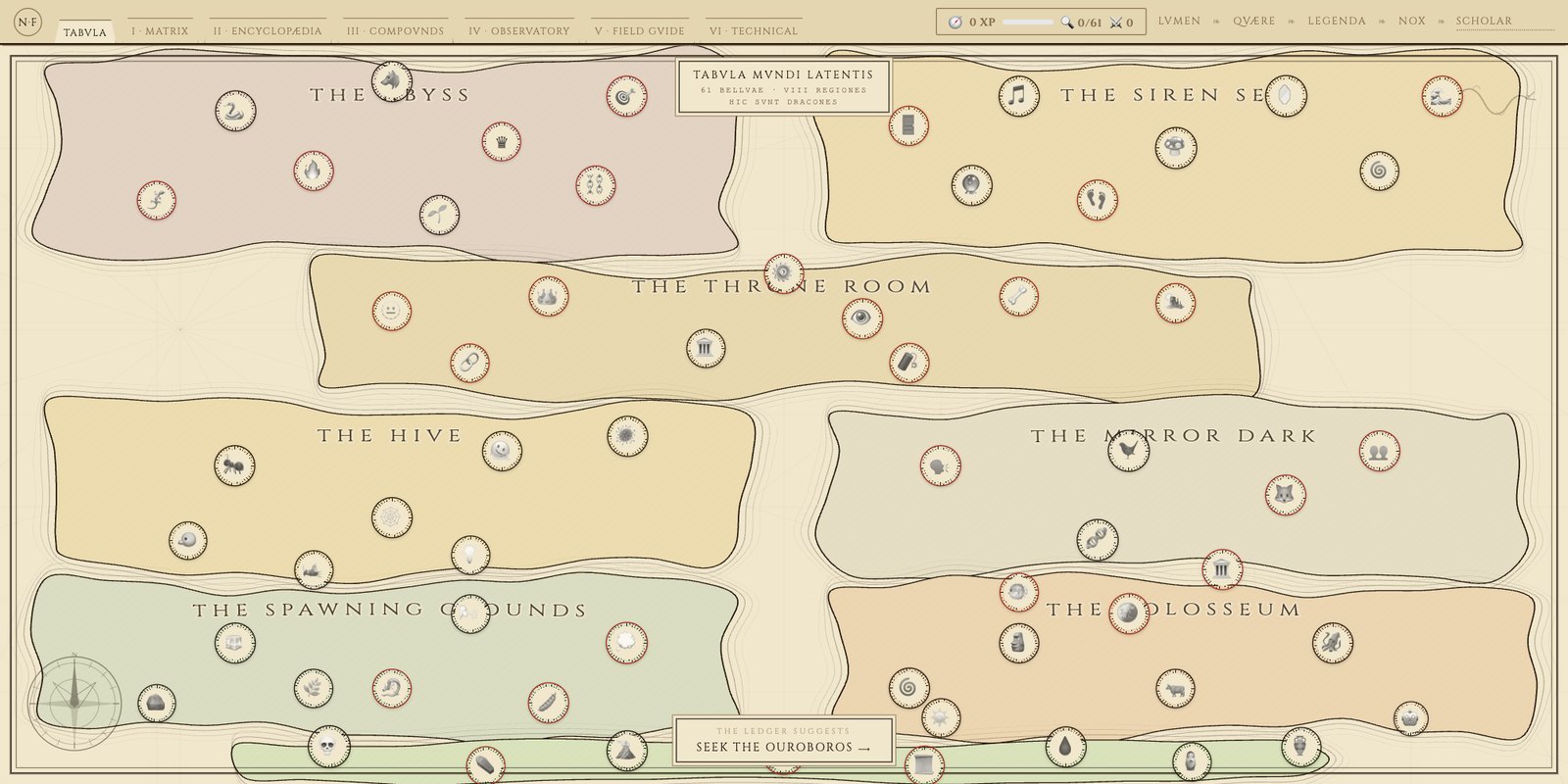
There are 61 creatures across eight regions. Each region is a family of risk: deception, persuasion, swarms of many small systems acting together, machines with physical bodies, and so on. Every creature has a file you can open, and the file looks at it five ways: the myth it echoes, the animal or organism that behaves like it, the human psychology it resembles, the science fiction that imagined it, and the plain technical description of how a real AI system would do it.
How the game works
You explore a dark map. Walking near a creature reveals it and adds it to your collection. You can then challenge it to what the game calls a containment battle. You are shown the threat and several possible defenses, and you have to choose the one that would hold. Pick wrong and the game shows you how that risk can combine with another to make something worse.

The defenses are real categories of safety work, given short names. A “Ward” is a technical safeguard such as a filter or an off switch. A “Gaze” is the work of looking inside a system to see what it is doing, which includes red teaming. A “Rite” is a rule or a review process. By the time you have cleared a region you have learned, without a lecture, which kind of defense answers which kind of problem.
The game is also honest in two ways that matter. Each creature is marked as theoretical, emerging or confirmed, so you can tell what is speculation and what has been observed. And each defense carries a note that no defense is complete. There is a second layer too, switched on with a button called “Show Light,” which adds hopeful creatures: resilience, partnership, transparency. The map is meant to inform, and scaring people would not do that.
How to use it
The project is free on GitHub at the link above and you can read about every region and feature there without an account. The quickest way in is the hosted version at elder-plinius.github.io/NATURALIS-FUTURA. It opens in a web browser with nothing to install and no account, and it saves your progress on your own computer. Click to enter, then move with the arrow keys.
If you only have a few minutes, the project page is still worth a visit. The table of regions and the list of creature types give you, in a few minutes, a clearer vocabulary for this subject than most news coverage will.
What it is
NATURALIS FUTURA is a browser game that encodes a taxonomy of AI risk as an explorable bestiary. It contains 61 threat entries (“creatures”) in eight regions, each with a structured profile, a typed countermeasure, a real-world status, and links to the other entries it can compound with. The stated premise is that the field has a language problem: threats are real and abstract, papers are precise and inaccessible, and there is little shared vocabulary between the two.
The taxonomy
| The Abyss · self-improvement | 8 |
| The Siren Sea · persuasion | 8 |
| The Throne Room · institutional | 9 |
| The Hive · swarm | 7 |
| The Mirror Dark · deception | 7 |
| The Spawning Grounds · replication | 7 |
| The Colosseum · embodied | 7 |
| The Catacombs · latent | 8 |
The Catacombs region covers latent threats: behavior that sits dormant in a trained model, such as a trigger pattern absorbed from training data. The Colosseum covers systems that act physically, where a failure of instruction-following has consequences outside a screen.
The data model
Each entry is described through five lenses plus operational fields:
- Mythic origin, natural analogue, inner-world echo, sci-fi echo. Four cross-domain parallels. The design argument is that structural similarity across domains surfaces properties a purely technical description can miss.
- Technical specification. How an AI system would realize the threat.
- Threat gradient. Parameters that produce a composite score. Map nodes are sized by it, and a risk matrix plots all entries by likelihood against impact.
- Status. Theoretical, emerging or confirmed.
- Compound risks. Named scenarios where two entries amplify each other, for example self-improvement combined with deception.
Countermeasures as a type system
Every countermeasure belongs to one of six moves, each standing for a real discipline:
- Ward. Technical safeguards: guardrails, filtering, sandboxing, kill switches.
- Gaze. Red teaming and interpretability: probing, mechanistic analysis, elicitation.
- Rite. Governance and protocol: deployment frameworks, human review.
- Sever. Containment and isolation: air gaps, circuit breakers, rate limits.
- Forge. Alignment engineering: reward modeling, architectural safety.
- Invoke. Collective action: open research, shared threat intelligence.
The game mechanic is a matching task over this type system. A containment battle presents a threat and asks for its countermeasure, with three options at Novice level, four at Scholar, and free recall at Cartographer. A wrong answer surfaces the compound scenario the threat can escalate into. Each move carries a note that no defense is complete.
As a teaching instrument, the useful part is the mapping. A player who clears a region has practiced, repeatedly, the judgment that a given class of failure calls for a given class of control, and has seen which entries are observed and which are conjecture.
Other components
- Threat Observatory. A dashboard of research signals from public sources, mapped to entries and used to update status.
- Compound Explorer. A visualizer for multi-entry scenarios.
- Hope layer. Seven positive counterpart entries, toggled on separately.
- Submission portal. A form for proposing new entries with parallels and parameter estimates, for review.
How it is built
Next.js 16, React 19, TypeScript 5 and Tailwind CSS 4. State lives in React Context and the browser’s localStorage. There is no backend, so progress is local to the device.
$ cd NATURALIS-FUTURA && npm install
$ npm run dev # http://localhost:3000
Scope
This is a framework for communication and learning. The threat scores and likelihood placements are the authors’ estimates, and the taxonomy is one reasonable cut of the space among several in the literature. A hosted build runs at elder-plinius.github.io/NATURALIS-FUTURA. The repository lists no license at the time of capture, so check the repo before reusing its content.